Beyond Likes and Reach: How to Measure Marketing That Actually Drives Business Growth


Your latest Instagram campaign reached 50,000 people. The posts received hundreds of likes, your followers increased, and the monthly marketing report looks promising. But when you check your sales, there isn't much of a difference.
Does that mean the campaign failed? Not necessarily. But it does raise an important question: Are you measuring how well your marketing performs, or how much it contributes to your business?
For D2C brands, especially those investing regularly in social media, influencer marketing and paid advertising, understanding this difference can help make better decisions about where to spend money and what to improve.
Likes and reach matter, but they don't tell the whole story
Reach tells you how many people saw your content. Likes, shares and comments show how people responded to it. These numbers are useful because they help you understand whether your brand is getting attention and connecting with an audience.
However, attention doesn't always translate into interest or purchases.
Imagine a skincare brand posting two different reels. The first is an entertaining video that reaches 100,000 people. The second is a product demonstration that reaches only 15,000 people but brings more visitors to the website and generates more orders.
The first reel may have helped introduce the brand to a wider audience, while the second encouraged people to consider buying the product. Both have value, but they serve different purposes.
The key is knowing what each marketing activity is supposed to achieve before deciding whether it worked.
Start with what your business actually needs
Every business has different priorities, and your marketing goals should reflect them.
A newly launched D2C brand might focus on introducing its products, building awareness and earning customer trust. An established brand might be more interested in increasing monthly orders, acquiring new customers or encouraging existing customers to buy again.
For example, if your goal is to increase online sales, the number of people liking an Instagram post shouldn't be your main measure of success. You should be looking at how many people visited your website, explored your products and eventually placed an order.
This doesn't mean every campaign needs to generate immediate sales. Brand-building activities can influence future purchases, while performance campaigns may focus on generating orders today. What matters is having a clear purpose for each.
Follow the journey from discovery to purchase
A customer rarely goes from seeing your brand for the first time to purchasing immediately. They might discover you through a reel, visit your Instagram profile, explore your website and return days later to place an order.
Understanding this journey helps you identify where your marketing is working and where potential customers are dropping off.
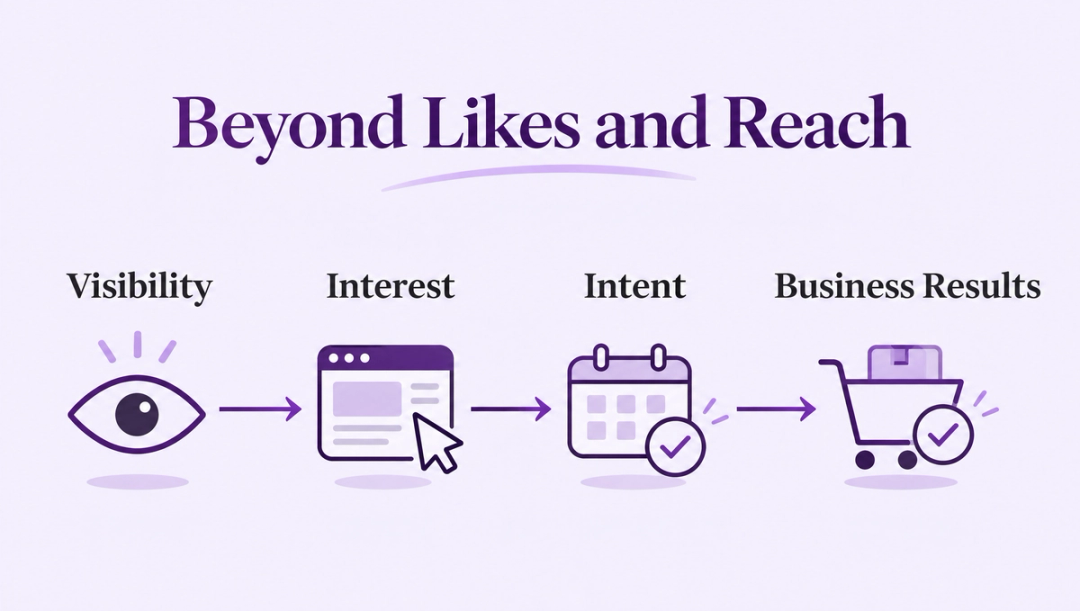
Here are four areas worth tracking:
- Visibility: How many people are discovering your brand? Look at reach, video views and how people find your business.
- Interest: Are people exploring what you offer? Track website visits, product-page views and meaningful interactions with your content.
- Purchase intent: Are they showing signs of buying? Look at products added to carts, checkout activity and genuine product enquiries.
- Business results: How many people actually purchased? Track orders, sales revenue, new customers and repeat purchases.
You don't need to track every number available on your dashboard. Start with the few that help explain how customers move from discovering your brand to buying from it.
Why bigger numbers don't always mean better marketing
Let's compare two imaginary campaigns for an online fashion brand. Both campaigns have the same advertising budget.
| Metric | Campaign A | Campaign B |
|---|---|---|
| People reached | 80,000 | 25,000 |
| Website visitors | 600 | 900 |
| Orders placed | 18 | 36 |
Campaign A reached more than three times as many people. Yet Campaign B brought in more website visitors and twice as many orders.
If the order values and margins are similar, Campaign B is likely delivering better sales results for the same investment.
This is why a smaller, more relevant audience can sometimes be more valuable than a large audience that isn't interested in buying.
The same principle applies to influencer collaborations, festive campaigns and even regular social media content. Rather than judging performance by reach alone, look at what happened after people discovered your brand.
Make your marketing reports useful for business decisions
A marketing report should help you decide what to continue, what to improve and where to invest next. It shouldn't simply be a collection of colourful charts and impressive-looking numbers.
For a D2C business, a useful monthly report should connect your marketing investment with website traffic, customer enquiries, purchases and revenue. It should also help you understand how much you're spending to acquire a customer.
For example, if website visits are increasing but orders aren't, the problem may not be your advertising. Your product pricing, website experience, delivery charges or checkout process could be affecting purchases.
Similarly, if customers are buying once but rarely returning, improving the post-purchase experience or customer retention strategy might be more useful than simply increasing your advertising budget.
Tracking isn't always perfect, and some customers may purchase after seeing your brand across several channels. But even a reasonably clear picture of your customer journey can help you make smarter decisions instead of relying on assumptions.
Measure progress, not just performance
Good marketing is not simply about reaching more people, gaining followers or generating engagement. It's about understanding how those activities support your business, whether that's building awareness, attracting the right customers, increasing purchases or encouraging repeat sales.
When you connect marketing metrics with business goals, you begin to see which activities are worth investing in and where improvements are needed.
At TCD, we approach marketing with this bigger picture in mind, connecting strategy, creative thinking and performance with what businesses actually want to achieve.
Because successful marketing isn't just about making your brand visible. It's about helping your business move forward.
Let's make your marketing work harder for your business.
Looking to understand what's working, what isn't and where your next growth opportunity could come from? Let's talk.