
A lot of founders are currently asking the same question: “Where can we use AI in our company?” I think that is already the wrong starting point. AI has become important enough that there is now a genuine fear of missing out, and founders see competitors announcing AI features, teams experimenting with agents, people talking about automation, and suddenly there is pressure to find something that can be called AI-powered.
A better starting point is much simpler: What is broken in the company, and what can be improved? Once you know that, you can decide what the right solution is. Sometimes that solution is AI. Sometimes it is traditional software. Sometimes it is an Excel sheet. And sometimes the best possible solution is still a human being. The objective should never be to use more AI. The objective should be to build a company that operates better.
Before AI, Get the Basics of Technology Right
One thing I still see surprisingly often, especially with younger D2C brands, is companies going to market without even getting the basic technology layer right. Analytics may not be configured properly, customer journeys are not being tracked, and events that will become incredibly useful later are never captured. Six months later, everyone wants to know why customers behave a certain way, but the historical data simply does not exist.
For a new business, some of these things are extremely inexpensive to solve. Setting up a basic analytics stack, identifying the important customer actions and making sure you are collecting useful data can often be done very early with very little effort. The value of that data compounds because the longer you collect it, the more useful it becomes.
At the other extreme, founders can over-engineer too early. I have seen businesses introduce full CRMs before they have enough customers to justify one, and the team ends up maintaining the software instead of the software making their lives easier. Sometimes an Excel or Google Sheet is genuinely the right answer.
This is why I would take AI out of the discussion initially and look at the company through three much simpler lenses:
Operations
Efficiency
Cost
Where is unnecessary time being consumed? Where are mistakes happening? What is expensive? What is not scaling? What information are we missing? Where are customers having a bad experience? Only after identifying those problems should technology enter the conversation.
I Think About These Problems in Four Layers
When evaluating an operational problem, I broadly think about four possible layers of solutions. These are not necessarily stages where every company has to move from one to the next. They are simply different categories of problems, and choosing the wrong category can create more inefficiency than the original problem.
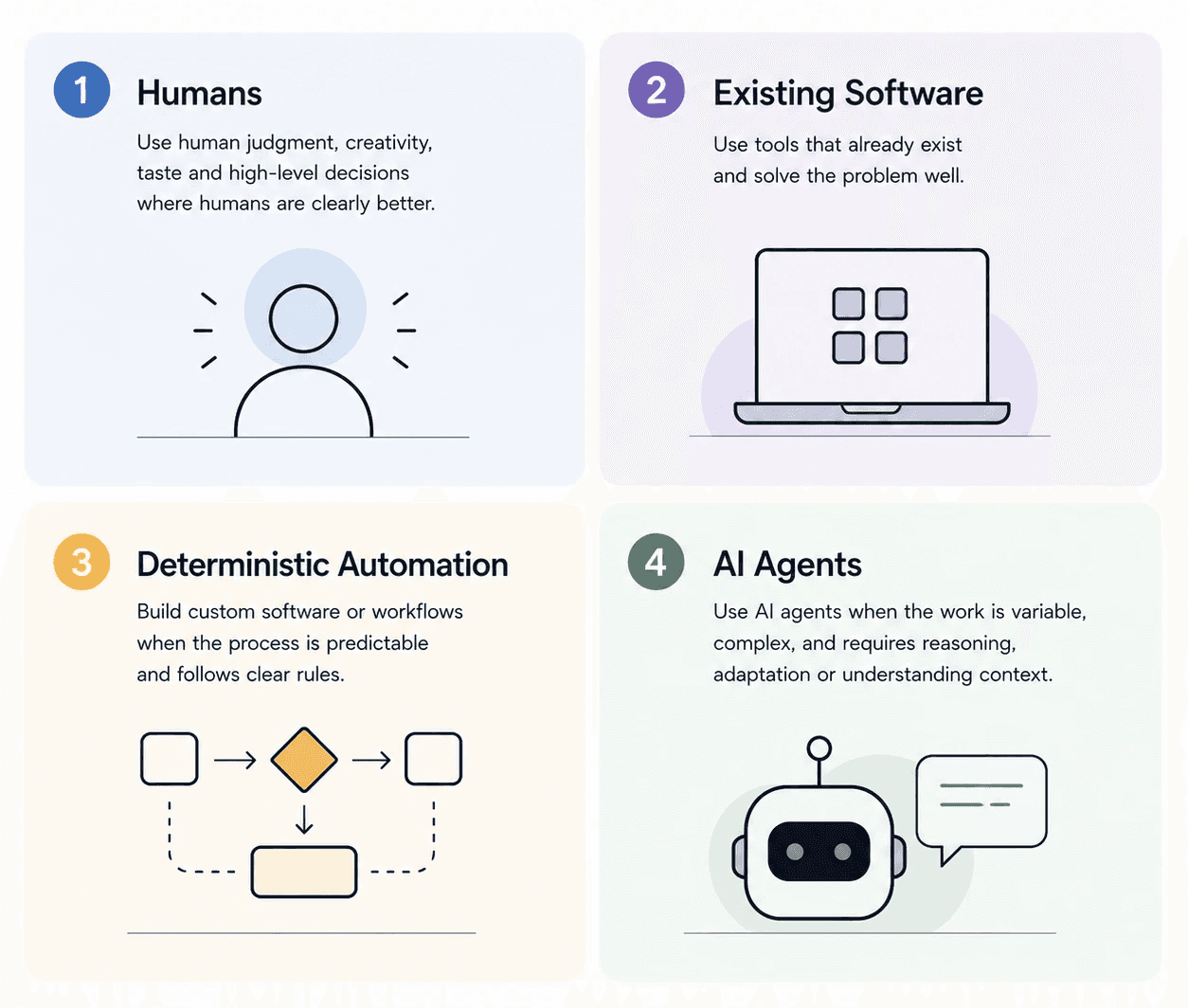
1. Work That Should Stay Human
There is currently a tendency to assume that if AI can attempt a task, we should eventually automate it. I do not agree with that. There are many areas where humans are still clearly superior, particularly when the work involves judgement, taste, high-level decisions, interpreting complicated situations, understanding people or dealing with consequences that cannot easily be quantified.
Strategy is an obvious example. AI can help with research, synthesis, simulations and challenging assumptions, but deciding which direction a company should take often depends on context that does not neatly exist inside a database. The same applies to taste. A system can produce ten designs, ten campaign ideas or ten product concepts, but determining which one feels right for a particular market may still be a fundamentally human decision.
Relationship building is another example. A founder talking to an important customer, an employee discussing a difficult situation with a manager, or two companies negotiating a complicated partnership cannot always be reduced to an automation workflow. The important question is not whether AI can technically perform some portion of the task. The question is whether replacing the human improves cost, quality, speed and overall output.
If the answer is no, keep the human. There is no point spending months trying to make AI perform work where it remains clearly inferior today.
2. Existing Technology
The next layer is the least exciting one, which is probably why it is often ignored. Someone may have already solved your problem, and if an existing CRM, accounting platform, analytics system, helpdesk, inventory platform or workflow tool solves most of your requirements, it will usually be cheaper and safer to use it.
There is absolutely no medal for building your own software. For common business problems, existing products have already gone through years of edge cases, security issues, integrations and improvements. Don't be stupid like me. I have tried this and it worked. Just for a couple of days. Then you run into the job a running another company within your company.
The decision should be economic. Does the existing system solve the problem well enough? Does adapting the business slightly to the tool make more sense than adapting the tool to the business? For smaller companies, the answer will often be yes, but not always.
3. Custom Deterministic Systems
Sometimes the problem is predictable, but existing software simply does not fit the workflow properly. This is where custom software starts making sense.
We had one such situation at TCD several years ago with quotations and invoicing. The products available at the time either did not support some of the workflows we needed, made certain kinds of currency handling unnecessarily difficult, lacked the level of design customization we wanted, or came with other compromises. So we built our own application.
The system handles our quotations, invoices and related workflows based on rules we define. There is nothing particularly “intelligent” about it. If an invoice is created, it receives an invoice number, date, due date, customer information, tax logic, line items, currency and totals. Everything follows structured rules.
This is what I mean by deterministic software: given the same input and the same rules, you should broadly receive the same output.
Building that application took me a couple of weeks at the time. Over roughly five years, I have probably spent only a few additional weekends making meaningful changes to it, and from that perspective, the investment was absolutely worth it.
What has changed now is the economics of building software. With modern AI-assisted development, an internal application that might have taken a developer two or three weeks several years ago can sometimes reach a useful first version within a weekend. You will still need testing, refinement and maintenance, but the barrier to building custom internal tools has dropped dramatically.
For small and medium-sized companies, this is an important shift. Historically, meaningful customization was often an enterprise luxury. Large organizations could get Salesforce implementations customized to their workflows or hire specialists to build systems around accounting platforms and ERPs, while smaller businesses often had to accept whatever off-the-shelf software offered.
AI-assisted development is changing that, but even here, we are still mostly talking about software, not agents. So if done for the right reason, this is your first no nonsense entry to using AI. Importantly, AI only works here to speed up things.
4. Agentic Systems
AI becomes more interesting when the problem itself is not fully deterministic. The task may involve understanding language, responding to different situations, adapting to people, interpreting information or deciding what to do next based on incomplete context.
Customer research is a useful example. Imagine you run a D2C brand. During the early stages of the company, I would strongly recommend that founders personally speak to customers because you can learn an extraordinary amount from those conversations.
You can ask:
Why did they buy the product?
What were they expecting?
What did they like?
What disappointed them?
What other products did they consider?
Would they buy again?
The problem is that this does not scale particularly well. Eventually, you might try other mechanisms to collect feedback such as QR codes on the packaging, forms, incentives, WhatsApp messages or actual phone calls after delivery.
We have experimented with variations of these methods in real customer research work. The specific numbers change depending on the audience and the offer, so I would not treat them as universal benchmarks. But the overall pattern we observed was unsurprising: passive mechanisms tend to receive relatively low participation, while actual conversations receive significantly more engagement.
The obvious problem with calling customers is cost. If the company grows, someone has to make those calls. You may eventually need employees, an agency or even a call center, and what initially looked like a great customer-research mechanism quickly becomes expensive to scale.
This is where an AI agent becomes interesting.
Feedback Method | Estimated Response / Feedback Rate | Useful Feedback from 1,000 Customers | Quality of Feedback | Scalability |
|---|---|---|---|---|
QR code on packaging | <1% | 5–10 | Low | Very High |
QR code + 10% incentive | 3–6% | 30–60 | Low–Medium | Very High |
WhatsApp 1 day after delivery | 2–4% | 20–40 | Medium | Very High |
Monthly WhatsApp + incentive | 4–8% | 40–80 | Medium | High |
Customers calling the company themselves | 1–3% | 10–30 | High, but biased | Low–Medium |
Company staff calling customers | 15–30% | 150–300 | Very High | Low |
AI voice agent calling customers | 10–18% | 100–180 | High | Very High |
What Would an AI Customer Research Agent Look Like?
Imagine a workflow where a customer places an order, the product is delivered, and the system knows when delivery occurred. It then waits until enough time has passed for the customer to realistically use the product.
Initially, the timing could be completely deterministic. For example, wait after delivery. Later, the system might become smarter, and the appropriate time to call could depend on the product, customer behavior, previous response data or patterns that emerge over hundreds of conversations.
Once the timing condition is met, an AI voice agent calls the customer. Instead of reading a fixed survey, it has a conversation. It asks whether the customer has used the product and, depending on the answer, decides what to ask next. It can explore dissatisfaction, ask follow-up questions, understand reasons behind positive responses and structure what it learns.
In India, multilingual capability makes this particularly interesting. A traditional survey forces the customer into the language and format designed by the company, while a voice agent can potentially adapt to the language the customer is most comfortable using.
At the end of the call, the system can structure the conversation into usable information:
What did the customer like?
What complaints came up?
Was the packaging a problem?
Was delivery an issue?
Would they repurchase?
Was there an unexpected use case?
Did they compare the product with another brand?
Suddenly, hundreds of unstructured conversations can become research data. That is a useful AI application, not because it looks futuristic, but because it solves a very specific operational problem.
So here's the rough estimate of the time approximation.
But an Agent Is Not Magic
This is where a lot of AI discussions become overly simplistic. The workflow I just described sounds straightforward when written in a few paragraphs, but building a good version is not.
You need to think about things such as:
When should the agent call?
How many times should it retry?
What should it do if the customer is busy or uninterested?
How should it handle different languages and accents?
What happens when the call fails?
How do you manage the economics of voice infrastructure?
How do you prevent numbers from getting flagged or blocked?
What should the agent record, and what should it ignore?
You also need to decide what success actually means. This is why I believe a useful AI agent should usually begin with a measurable baseline.
In the customer-research example, we already have several existing mechanisms against which the AI system can be compared. We know roughly how QR codes perform, how WhatsApp performs and what happens when humans call customers.
Human calls may currently be the best-performing option. Great. That gives us a benchmark.
The AI does not necessarily need to outperform humans on every metric from day one. Suppose human calls produce much better conversations, but AI produces slightly lower-quality conversations at a fraction of the cost and can reach ten times as many customers. That may still make the AI system economically valuable.
So we measure things such as:
Percentage of customers who answer
Percentage of conversations that reach completion
Cost per useful conversation
Quality of the feedback collected
Performance across different languages
Call failure rates
Number of useful insights generated
Improvement in the system over time
Only then can we determine whether the agent is actually useful.
To break it down it could look something like this,
Metric | Human Calling | AI Voice Agent |
|---|---|---|
Customers contacted | 1,000 | 1,000 |
Expected useful response rate | 20–25% | 10–15% |
Useful conversations | 200–250 | 100–150 |
Human time required / month | 80–100 hrs | 5–10 hrs |
Estimated operating cost | ₹25,000–₹35,000* | ₹8,000–₹15,000 |
Cost per useful conversation | ₹100–₹175* | ₹55–₹150* |
Ability to scale to 10,000 calls | Difficult | Relatively easy |
Multiple languages | Requires multilingual staff | Can be built into the system |
Consistency of questions | Medium | High |
Improvement from accumulated data | Mostly manual | Can be systematically built in |
*The cost mentioned is sample figure to give an idea. This cost also only considers the running costs and not the build cost.
The interesting comparison here is not “AI beats humans.” Humans may still produce a better conversation and get a substantially higher response rate. The efficiency comes from the system being able to reach far more customers without human effort increasing proportionately.
For example, you could make the contrast even more visual in the article:
For every 1,000 customers
Human calls
100 hours → ₹30,000 → ~225 useful conversations
AI agent
8 hours of oversight → ₹12,000 → ~130 useful conversations
The human system produces better output per call. The AI system potentially produces better output per rupee and per hour of human effort, while also being much easier to scale.
The First Version Is the Easy Part
There is another misconception around agents that founders should be careful about. Building the first working prototype is increasingly easy. You can connect a voice system, a model, order data and a database and have something working relatively quickly.
That does not mean you have a good agent.
The actual value comes from what happens over the next several weeks or months. Perhaps customers respond better at 6 PM than at 11 AM. Perhaps a particular opening line creates more hang-ups. Maybe customers in one region prefer a different language mix. Maybe one question consistently produces useless answers while another reveals important purchasing behavior.
A good system should capture these failures and improve. This is one of the conditions I think matters enormously when building useful agentic systems: there should be an improvement loop.
The system should not simply execute the same prompt forever. The workflow around it should allow you to understand failures, change behavior, test improvements and eventually incorporate what has been learned. This is where agents slowly move from impressive demos into actual operational infrastructure.
AI Is Changing What Smaller Companies Can Afford
This is ultimately what I find most interesting about all of this. Most of the individual ideas I have described are not new. Large companies have been doing sophisticated customer research for years, and they have research teams, call centers, customized CRMs, enterprise analytics systems and armies of consultants.
Custom automation is also not new. Enterprise companies have paid huge amounts of money for tailored software for decades. What AI changes is accessibility.
A smaller D2C company may now be able to build an internal tool that previously did not make economic sense. A startup may be able to analyze thousands of customer conversations without hiring a large research team. A company that could never justify a full call center may eventually be able to run targeted multilingual customer interviews at a viable cost.
Not everything is ready today. Voice agents can still be expensive, reliability remains uneven, and some systems require considerably more engineering than their demos suggest. But the direction is clear: the cost of customized software and semi-autonomous work is falling, and that creates opportunities for smaller businesses that historically had to operate with much simpler infrastructure.
Start With the Company, Not With AI
If you are a founder who feels like everyone around you is adopting AI and you are somehow falling behind, I would not begin by searching for AI use cases. Look at your company instead.
Talk to your team, look at where time is going, look at what customers complain about, find where information gets lost, and identify processes that are expensive, repetitive or impossible to scale. Then work through these questions in order:
What is broken? What can be improved?
Can humans solve it?
Does existing software solve it?
Can deterministic automation solve it?
Only then: does this need an AI agent?
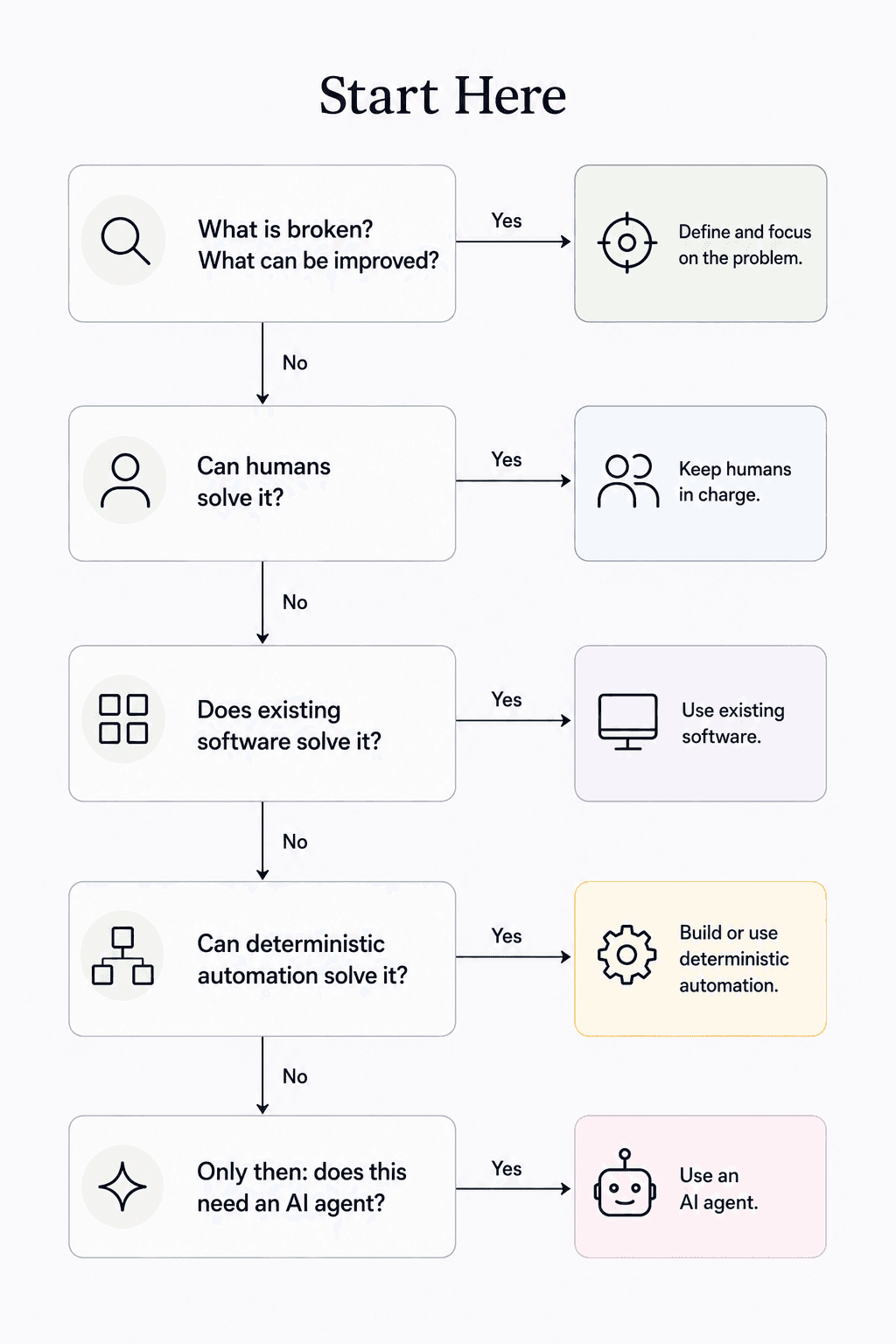
The companies that benefit most from AI may not be the companies that use the most AI. They will probably be the ones that understand where humans, traditional software, automation and AI each belong, and choose the right tool based on the problem rather than the trend.