
Your Website Is Not a Brochure. It’s a Signal Engine.
Your Website Is Not a Brochure. It’s a Signal Engine.
Key Takeaway
Key Takeaway
From the Field
We once worked with a D2C brand that came to us after running ads for a while but struggling to scale. They were spending serious money on ads and were getting traffic, but performance was inconsistent. Some weeks were good, some weeks were not. When we looked into the setup, we noticed something very common.
Most of the signal infrastructure was missing. The Ads platform had very limited information about what was actually happening on the website.
Conversion tracking was incomplete, and there was no structured way of sending data back to the Ads platform.
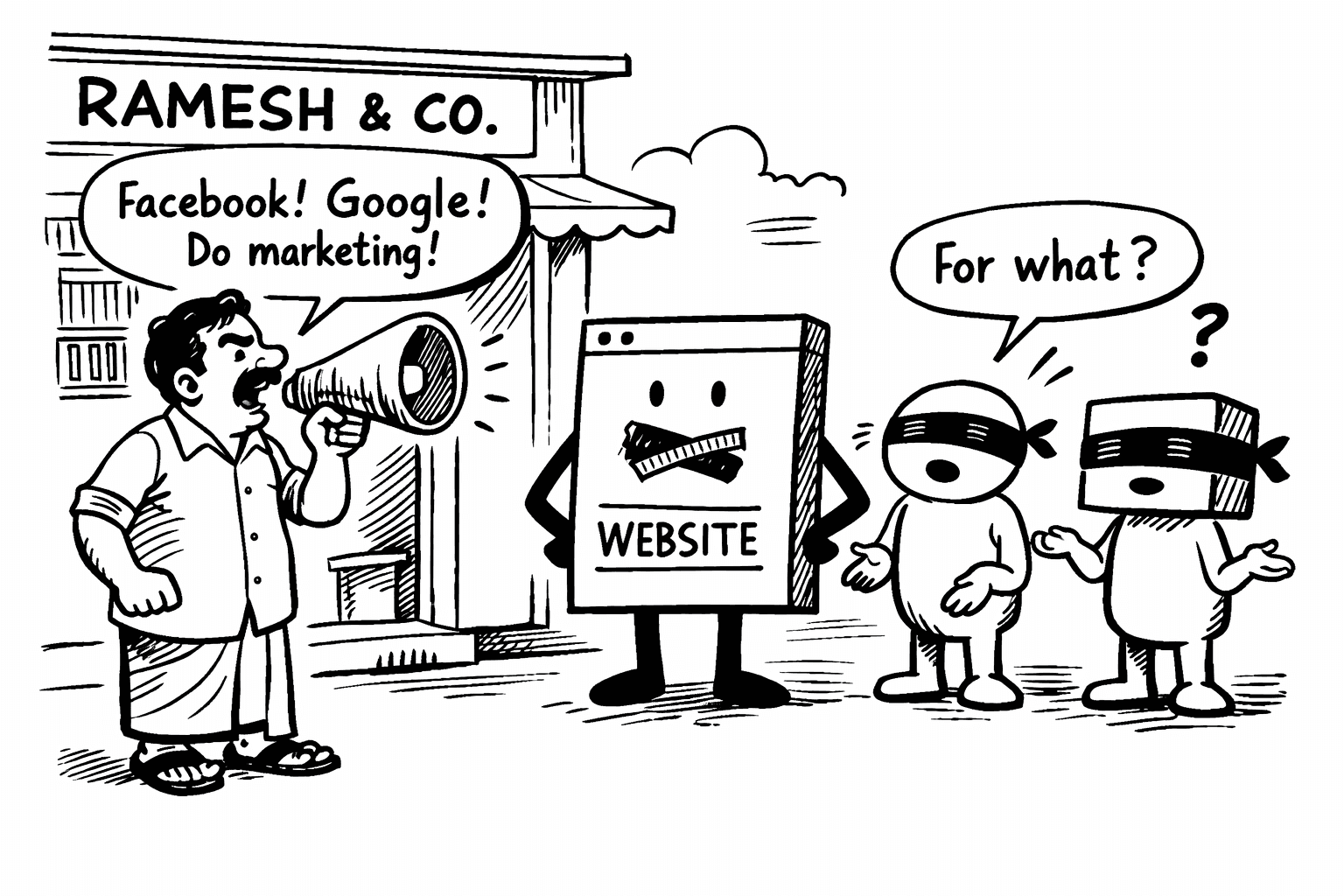
Which, if you think about it, is a bit like hiring a sales team and then refusing to tell them what product you’re selling.
So the first thing we did was fairly simple. We set up proper tracking:
Meta Pixel
Conversion API
Tracking important actions like purchases, add-to-cart and leads
Analytics and behavioral tracking (this one for us, because we love data)
Nothing complicated.
The important part was that the system finally started receiving consistent signals about what users were doing.
Over the next few months something interesting started happening. The platform slowly began identifying patterns. The cost of conversions started stabilizing, and the system became better at finding customers.
It didn’t happen overnight. But as more data accumulated, the platform’s optimization improved gradually.
What we were essentially doing was helping the system understand:
what the product was
who the customers were
what a successful conversion looked like
Once the platform had enough signals, the performance improvements became much more predictable.
The number of brands that come to us without this setup is surprisingly high. And it’s rarely because the setup is complicated. Most of the time nobody told them it mattered.
And every time I see it, I have the same reaction: "Ah… Only if this was done earlier…". This is precisely why I'm writing about this article. To solve that "only if".
Once You See It, You Start Seeing It Everywhere
What we did there wasn’t some advanced growth hack or a clever advertising trick. In fact, it was the opposite. We simply made sure the system had enough information to understand what was happening. Most of that information comes from the one digital asset businesses actually control — their website.
Many companies spend enormous amounts of time thinking about ads, creatives, and targeting strategies. But the one thing sitting quietly in the middle of all this — the website — is often doing almost nothing.
It just sits there. Looking pretty. Like a brochure.
But modern marketing systems don’t care much about how pretty your website looks. They care about the content it has the and signals it sends. And in many cases, those signals are either missing, incomplete, or never set up in the first place.
Which means the system trying to understand your business is working with very little information.
And Then We Blame the Platform
When performance drops, the reaction is usually predictable.
“Meta ads aren’t working anymore”
"SEO is dead"
Sometimes that’s true. But more often, the system is simply working with very limited information. It’s trying to make decisions without really understanding what success looks like for your business.
Something Has Quietly Changed in Marketing
Something has been happening in marketing for quite some time now. It didn’t change overnight, but slowly and steadily it has become more visible.
If you look back a few years, platforms like Meta Ads gave marketers a lot of control over targeting. You could select interests, behaviors, and very specific audience segments and manually decide who should see your ads.
Oh, it’s still there. But not like how it used to be.
If you look at the platform today, that control has reduced significantly. Most of the time when you create an ad, the targeting options are fairly simple: geography, an age range, and sometimes gender preferences. Beyond that there is very little hard targeting you can actually define.
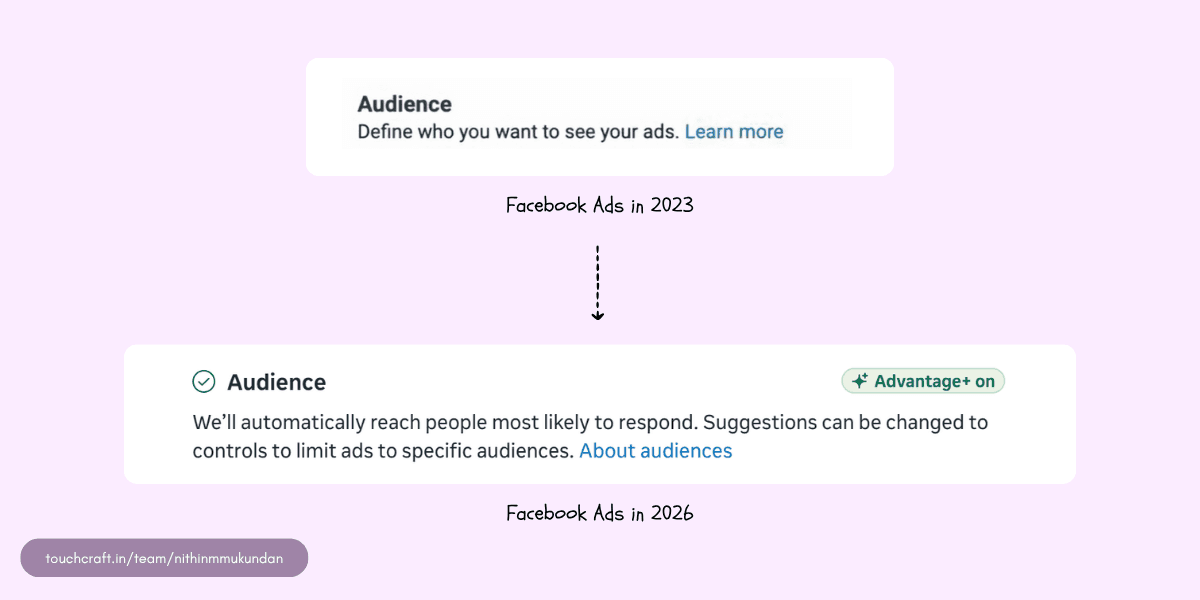
I’ve personally sat in meetings where we debated targeting combinations for hours. Meanwhile the platform had already moved on from that game years ago.
Even when you provide suggestions for targeting, what we’ve seen from experience running ads is that these suggestions are only partially used. Maybe around 20–25% of the targeting comes from the inputs you provide, while the remaining 75–80% is determined by the platform itself.
How do I know? I just ran a campaign last week to target only female audience and guess what? The ads reached out to 60% female and 40% male. Oh its not Meta Ads being gender neutral.
Because the system believes it can find the right audience better than we can. And honestly… sometimes it does.
Why The Platforms Now Think They Know Better
One of the reasons this shift happened is the scale at which these platforms operate today and the changes happening around privacy, tracking and of course AI. I'm not going deeper but you have first hand experienced what AI can do in the last 2-3 years and how far along it has come. It can now decipher text, images, videos etc.
But there is another reality here that people don’t like admitting. The platforms now control the data. Which means you are becoming more reliant on them.
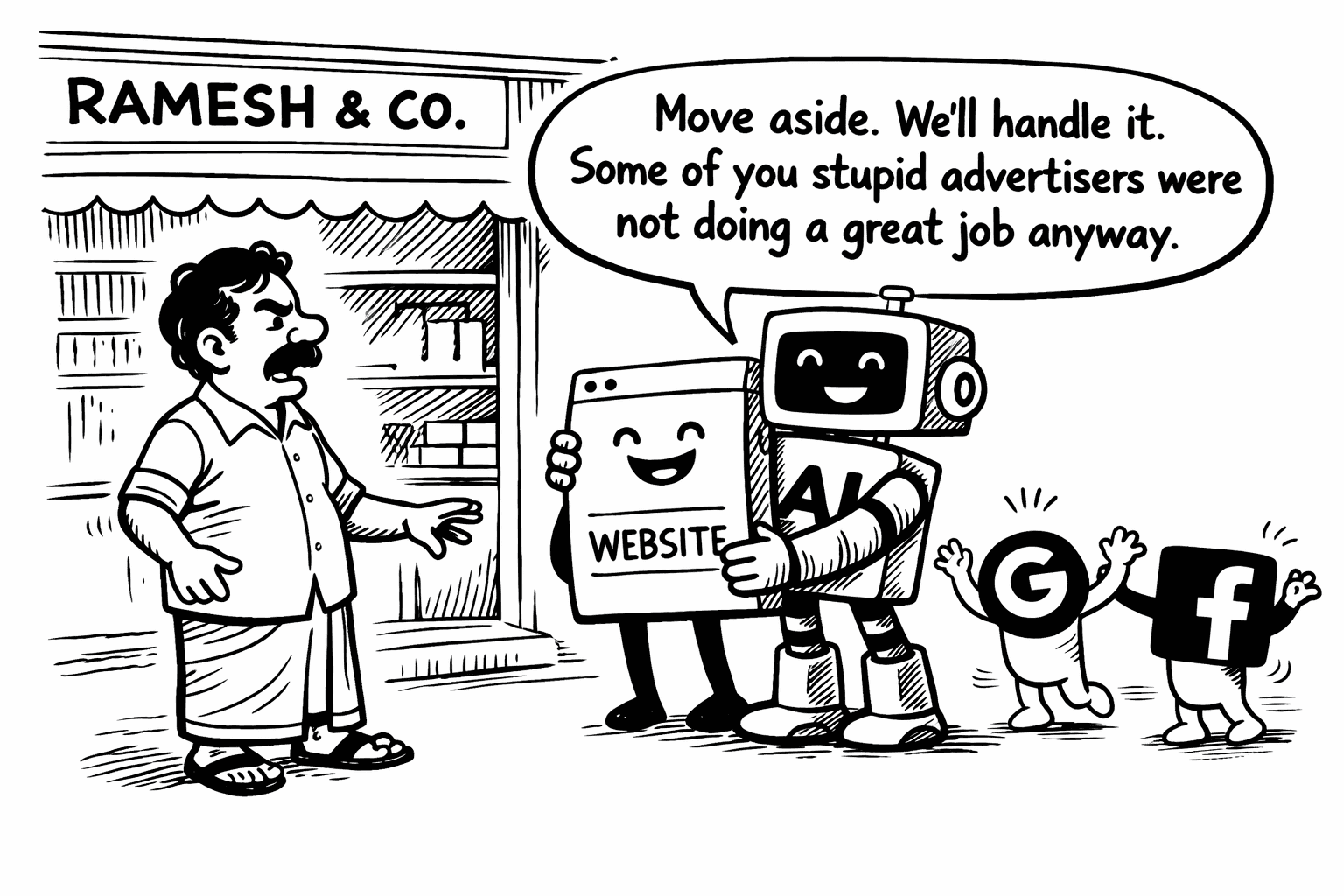
The platform is essentially saying: “Relax. We’ll find the customers.”
And to be fair… sometimes that’s not entirely wrong. Because if you look back at some of the targeting strategies people used to run, a lot of them were basically random guesses dressed up as strategy.
People would spend hours debating interest combinations like they were solving a physics problem.
Meanwhile the platform is running machine learning models analyzing thousands of signals every second. Platforms now operate with billions of users. At that scale, manual targeting simply stops working.
Platforms today rely on AI systems that analyze thousands of behavioral signals in real time. They’re no longer just delivering ads — they’re predicting human behavior: what catches your attention, what triggers action, and how likely you are to click on that shady incognito tab.
The System Sitting Between You and Your Customers
One way to understand this is to imagine the advertising platform as an intelligent salesman sitting between your product and your potential customers.
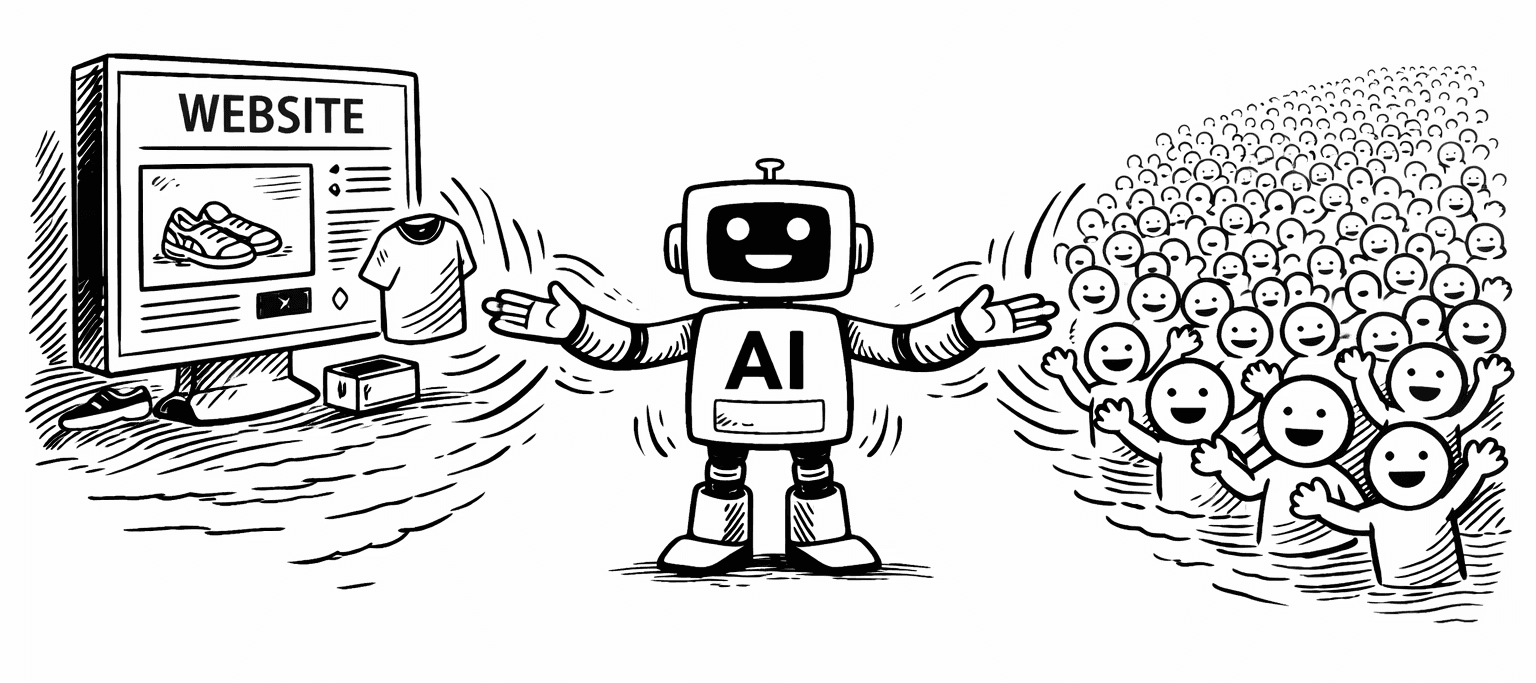
On one side you have your product and your website. On the other side you have millions of users on the platform. And right in between sits the AI system trying to connect the two.
Its job is simple: figure out who is most likely to respond to your product. But to do that the system needs information. And it doesn’t just look at one thing. It looks at everything.
For example it looks at:
your ad creatives
your landing pages
your product information
your pricing
your past purchasers
user interactions on your website
how people behave across platforms
your social media audience
All of these signals help the system understand what kind of product you are selling and which type of audience might respond to it.
Modern ad platforms are essentially probability engines. They analyze thousands of signals and try to predict which user has the highest probability of converting.
In the past marketers told the platform who the customer was.
Today the platform tries to discover the customer on its own.
What Are These Signals?
Signals are the pieces of data that go back to the platform about what users are doing.
Page views.
Product views.
Purchases.
Lead submissions.
All the things that actually tell the system what is happening.
Platforms don’t optimize campaigns.
They optimize signals.
While signals are sent back to advertising platforms, you also need systems that help you understand what is happening on your website.
Tools like Google Analytics help track traffic and conversions. But one platform that I personally find extremely useful is Microsoft Clarity.
It lets you see how users actually interact with your website through heatmaps and session recordings. You can see where people click, where they scroll, and where they get stuck. Which is incredibly useful when you’re trying to understand what is really happening.
And the best part? It’s completely free. Now that’s always nice.
The Small Data Problem
One of the things that is often overlooked is the amount of data these systems need to learn properly. If your website only receives a handful of visitors every week, the platform simply does not have enough signals to work with.
For example, if your website receives around 100 visitors in a month, that is still a very small dataset.
Sometimes advertisers expect the platform to magically optimize campaigns with numbers like that. Unfortunately the AI systems are powerful. But they are not magicians. You can’t feed the system three conversions and expect it to suddenly understand your entire customer base.
Why This Should Be Set Up From Day One
The irony is that most of these setups are not complicated. In many cases they can be implemented in an hour or so.
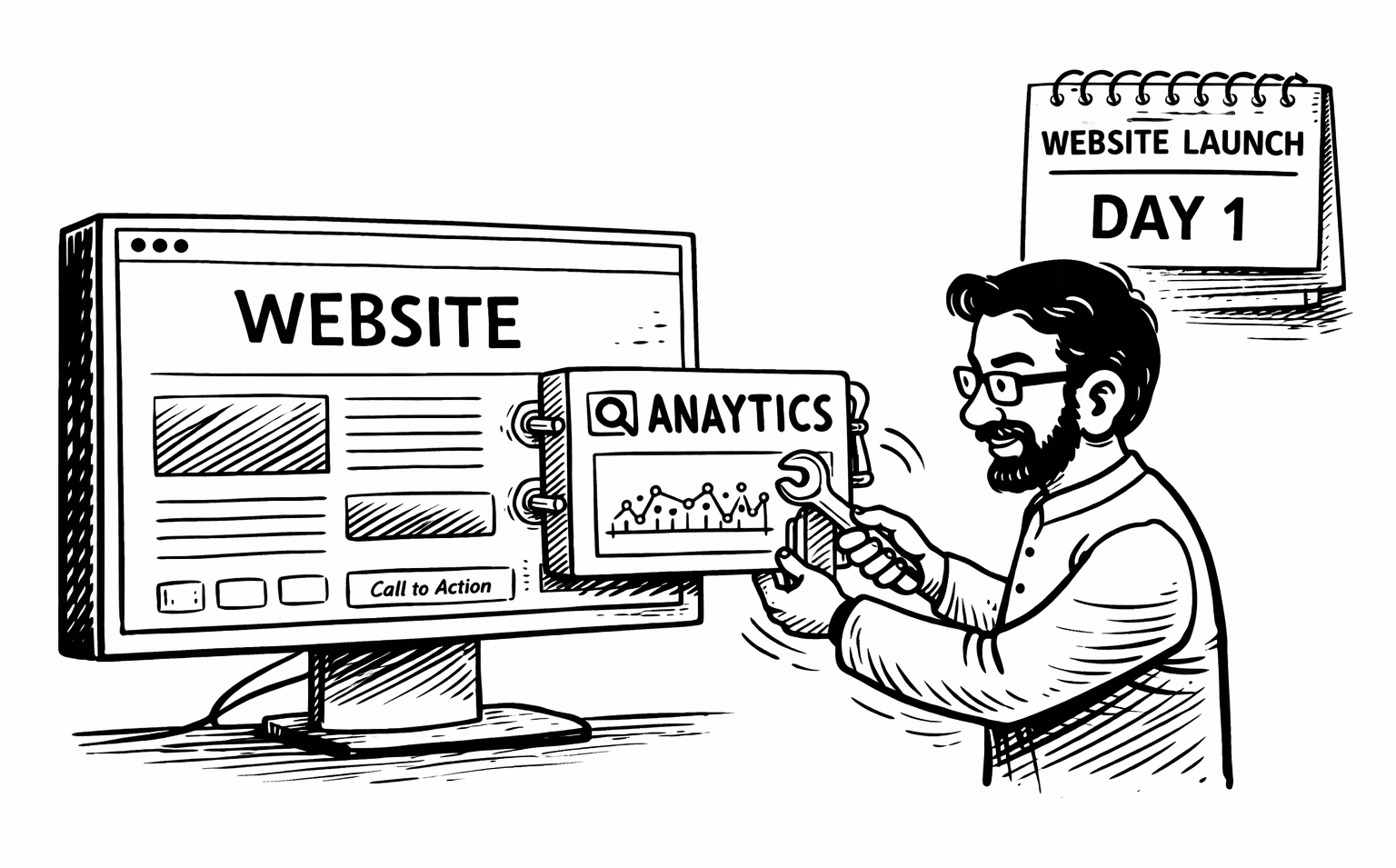
Yet a surprising number of businesses run ads for months without them. Which means the platform spends months guessing what is happening on the website. And then everyone wonders why the campaigns are “not performing.”
If You Only Do One Thing, Do This
If you are a founder that just launched a website or have an untracked website do this now and thank me later. Go ahead and have the following systems set up:
Meta Pixel - The base Meta tracker
Meta Conversion API - The advanced Meta tracker. (optional but highly recommended)
Google Analytics 4 - The website users tracker.
Microsoft Clarity - The heatmap tracker for website users.
Google Tag Manager - This is not a tracker but a container where you can put all the above trackers.
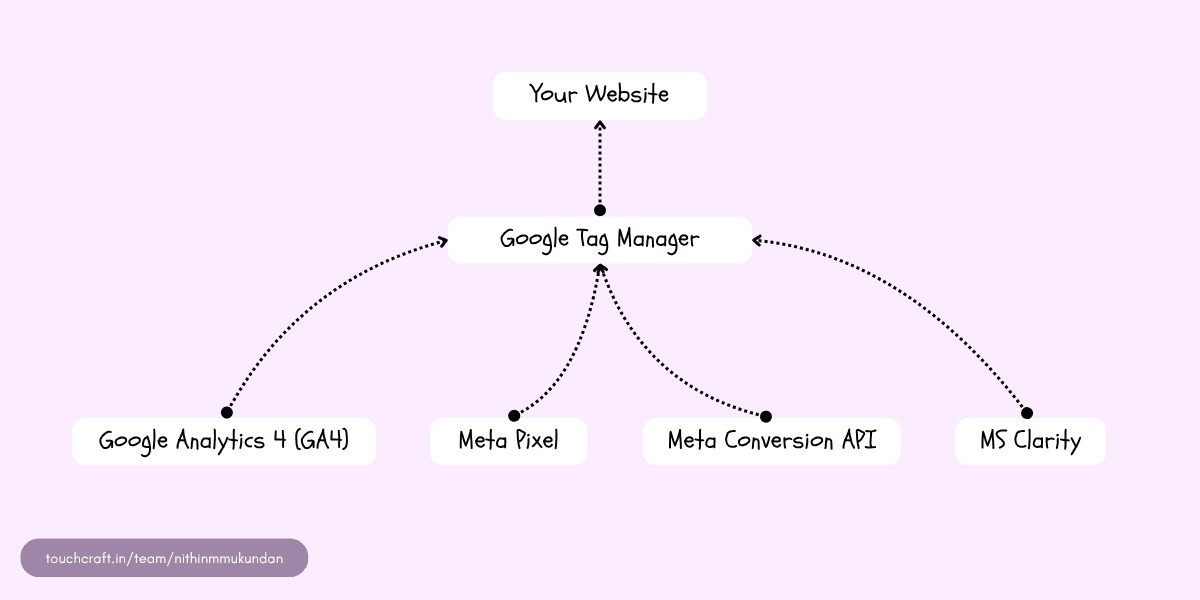
This is not some enterprise-level setup. This is basic infrastructure.
The Job of Marketers Is Changing
Marketing used to be about manually identifying and targeting the right audience. Today platforms are increasingly discovering the audience on their own.
What they need from us is context and signals. In many ways the role of marketers is shifting. It is no longer just about creating ads. It is about helping intelligent systems understand your business. Just like when you write a prompt for an AI system — the more context you provide, the better the output you get.
The same principle applies here. The more information and signals you give these platforms, the better they are able to connect your product with the right customers.
At TCD we love data. To us, data is what oil is to the United States. Without it, the entire system runs on assumptions.
People often think this kind of setup is complicated or meant only for large companies. It isn’t. Most of this can be set up in 30 minutes. And if you do it from day one, you are effectively saving yourself six months of learning later.
Key Takeaway
From the Field
We once worked with a D2C brand that came to us after running ads for a while but struggling to scale. They were spending serious money on ads and were getting traffic, but performance was inconsistent. Some weeks were good, some weeks were not. When we looked into the setup, we noticed something very common.
Most of the signal infrastructure was missing. The Ads platform had very limited information about what was actually happening on the website.
Conversion tracking was incomplete, and there was no structured way of sending data back to the Ads platform.
Which, if you think about it, is a bit like hiring a sales team and then refusing to tell them what product you’re selling.
So the first thing we did was fairly simple. We set up proper tracking:
Meta Pixel
Conversion API
Tracking important actions like purchases, add-to-cart and leads
Analytics and behavioral tracking (this one for us, because we love data)
Nothing complicated.
The important part was that the system finally started receiving consistent signals about what users were doing.
Over the next few months something interesting started happening. The platform slowly began identifying patterns. The cost of conversions started stabilizing, and the system became better at finding customers.
It didn’t happen overnight. But as more data accumulated, the platform’s optimization improved gradually.
What we were essentially doing was helping the system understand:
what the product was
who the customers were
what a successful conversion looked like
Once the platform had enough signals, the performance improvements became much more predictable.
The number of brands that come to us without this setup is surprisingly high. And it’s rarely because the setup is complicated. Most of the time nobody told them it mattered.
And every time I see it, I have the same reaction: "Ah… Only if this was done earlier…". This is precisely why I'm writing about this article. To solve that "only if".
Once You See It, You Start Seeing It Everywhere
What we did there wasn’t some advanced growth hack or a clever advertising trick. In fact, it was the opposite. We simply made sure the system had enough information to understand what was happening. Most of that information comes from the one digital asset businesses actually control — their website.
Many companies spend enormous amounts of time thinking about ads, creatives, and targeting strategies. But the one thing sitting quietly in the middle of all this — the website — is often doing almost nothing.
It just sits there. Looking pretty. Like a brochure.
But modern marketing systems don’t care much about how pretty your website looks. They care about the content it has the and signals it sends. And in many cases, those signals are either missing, incomplete, or never set up in the first place.
Which means the system trying to understand your business is working with very little information.
And Then We Blame the Platform
When performance drops, the reaction is usually predictable.
“Meta ads aren’t working anymore”
"SEO is dead"
Sometimes that’s true. But more often, the system is simply working with very limited information. It’s trying to make decisions without really understanding what success looks like for your business.
Something Has Quietly Changed in Marketing
Something has been happening in marketing for quite some time now. It didn’t change overnight, but slowly and steadily it has become more visible.
If you look back a few years, platforms like Meta Ads gave marketers a lot of control over targeting. You could select interests, behaviors, and very specific audience segments and manually decide who should see your ads.
Oh, it’s still there. But not like how it used to be.
If you look at the platform today, that control has reduced significantly. Most of the time when you create an ad, the targeting options are fairly simple: geography, an age range, and sometimes gender preferences. Beyond that there is very little hard targeting you can actually define.
I’ve personally sat in meetings where we debated targeting combinations for hours. Meanwhile the platform had already moved on from that game years ago.
Even when you provide suggestions for targeting, what we’ve seen from experience running ads is that these suggestions are only partially used. Maybe around 20–25% of the targeting comes from the inputs you provide, while the remaining 75–80% is determined by the platform itself.
How do I know? I just ran a campaign last week to target only female audience and guess what? The ads reached out to 60% female and 40% male. Oh its not Meta Ads being gender neutral.
Because the system believes it can find the right audience better than we can. And honestly… sometimes it does.
Why The Platforms Now Think They Know Better
One of the reasons this shift happened is the scale at which these platforms operate today and the changes happening around privacy, tracking and of course AI. I'm not going deeper but you have first hand experienced what AI can do in the last 2-3 years and how far along it has come. It can now decipher text, images, videos etc.
But there is another reality here that people don’t like admitting. The platforms now control the data. Which means you are becoming more reliant on them.
The platform is essentially saying: “Relax. We’ll find the customers.”
And to be fair… sometimes that’s not entirely wrong. Because if you look back at some of the targeting strategies people used to run, a lot of them were basically random guesses dressed up as strategy.
People would spend hours debating interest combinations like they were solving a physics problem.
Meanwhile the platform is running machine learning models analyzing thousands of signals every second. Platforms now operate with billions of users. At that scale, manual targeting simply stops working.
Platforms today rely on AI systems that analyze thousands of behavioral signals in real time. They’re no longer just delivering ads — they’re predicting human behavior: what catches your attention, what triggers action, and how likely you are to click on that shady incognito tab.
The System Sitting Between You and Your Customers
One way to understand this is to imagine the advertising platform as an intelligent salesman sitting between your product and your potential customers.
On one side you have your product and your website. On the other side you have millions of users on the platform. And right in between sits the AI system trying to connect the two.
Its job is simple: figure out who is most likely to respond to your product. But to do that the system needs information. And it doesn’t just look at one thing. It looks at everything.
For example it looks at:
your ad creatives
your landing pages
your product information
your pricing
your past purchasers
user interactions on your website
how people behave across platforms
your social media audience
All of these signals help the system understand what kind of product you are selling and which type of audience might respond to it.
Modern ad platforms are essentially probability engines. They analyze thousands of signals and try to predict which user has the highest probability of converting.
In the past marketers told the platform who the customer was.
Today the platform tries to discover the customer on its own.
What Are These Signals?
Signals are the pieces of data that go back to the platform about what users are doing.
Page views.
Product views.
Purchases.
Lead submissions.
All the things that actually tell the system what is happening.
Platforms don’t optimize campaigns.
They optimize signals.
While signals are sent back to advertising platforms, you also need systems that help you understand what is happening on your website.
Tools like Google Analytics help track traffic and conversions. But one platform that I personally find extremely useful is Microsoft Clarity.
It lets you see how users actually interact with your website through heatmaps and session recordings. You can see where people click, where they scroll, and where they get stuck. Which is incredibly useful when you’re trying to understand what is really happening.
And the best part? It’s completely free. Now that’s always nice.
The Small Data Problem
One of the things that is often overlooked is the amount of data these systems need to learn properly. If your website only receives a handful of visitors every week, the platform simply does not have enough signals to work with.
For example, if your website receives around 100 visitors in a month, that is still a very small dataset.
Sometimes advertisers expect the platform to magically optimize campaigns with numbers like that. Unfortunately the AI systems are powerful. But they are not magicians. You can’t feed the system three conversions and expect it to suddenly understand your entire customer base.
Why This Should Be Set Up From Day One
The irony is that most of these setups are not complicated. In many cases they can be implemented in an hour or so.
Yet a surprising number of businesses run ads for months without them. Which means the platform spends months guessing what is happening on the website. And then everyone wonders why the campaigns are “not performing.”
If You Only Do One Thing, Do This
If you are a founder that just launched a website or have an untracked website do this now and thank me later. Go ahead and have the following systems set up:
Meta Pixel - The base Meta tracker
Meta Conversion API - The advanced Meta tracker. (optional but highly recommended)
Google Analytics 4 - The website users tracker.
Microsoft Clarity - The heatmap tracker for website users.
Google Tag Manager - This is not a tracker but a container where you can put all the above trackers.
This is not some enterprise-level setup. This is basic infrastructure.
The Job of Marketers Is Changing
Marketing used to be about manually identifying and targeting the right audience. Today platforms are increasingly discovering the audience on their own.
What they need from us is context and signals. In many ways the role of marketers is shifting. It is no longer just about creating ads. It is about helping intelligent systems understand your business. Just like when you write a prompt for an AI system — the more context you provide, the better the output you get.
The same principle applies here. The more information and signals you give these platforms, the better they are able to connect your product with the right customers.
At TCD we love data. To us, data is what oil is to the United States. Without it, the entire system runs on assumptions.
People often think this kind of setup is complicated or meant only for large companies. It isn’t. Most of this can be set up in 30 minutes. And if you do it from day one, you are effectively saving yourself six months of learning later.
From marketing strategy to campaign execution, we take care of it all. The emphasis here is on creating growth.
© TouchCraft Digital Private Limited
From marketing strategy to campaign execution, we take care of it all. The emphasis here is on creating growth.
© TouchCraft Digital Private Limited
From marketing strategy to campaign execution, we take care of it all. The emphasis here is on creating growth.
© TouchCraft Digital Private Limited